When I started my PhD journey at the University of Cyprus back in 2010, joining the KIOS Center of Excellence, I carried with me a background in engineering, software systems, and artificial intelligence technologies. What I didn’t yet realize was how these worlds would merge into a research direction with real potential to impact society.
I owe this transformation first to my academic supervisors and second to my colleagues at KIOS (names intentionally avoided here, though my respect and gratitude for each of them remain immense). Their guidance, ideas, and trust shaped the way I think as a researcher. They helped me channel curiosity and ambition toward real-world challenges, specifically, how large-scale, interconnected systems such as critical infrastructures and smart buildings can monitor themselves, adapt to change, and remain resilient.
At that time, the Internet of Things (IoT) was just beginning to take shape. We saw a huge opportunity: billions of connected devices generating data that could enhance the intelligence of control systems, but also introduce new layers of complexity. Monitoring architectures were becoming mature, yet one question persisted: how could we make control systems flexible enough to reconfigure themselves automatically, without waiting for an engineer to redesign them every time something changed?
That question became the heart of my PhD research and led to the creation of "SEMIoTICS -Semantically-enhanced IoT-enabled Intelligent Control Systems". SEMIoTICS introduced a way for control systems to understand and reason about their components (sensors, actuators, controllers) much like engineers do, through semantic knowledge graphs and logic-based reasoning. In practical terms, this meant that systems such as smart buildings could reconfigure themselves on the fly, maintaining energy efficiency, comfort, and safety even when devices were added, removed, or failed.
Looking back, what excites me most is how this vision connects to today’s AI revolution. With the rise of agentic AI and autonomous reasoning tools, the ideas behind SEMIoTICS (self-configuring, knowledge-driven control) are closer than ever to becoming mainstream. The future of intelligent systems is not just about data or automation; it’s about AI systems that can design, adapt, and optimize themselves, bridging engineering intelligence with artificial intelligence for tangible societal impact.
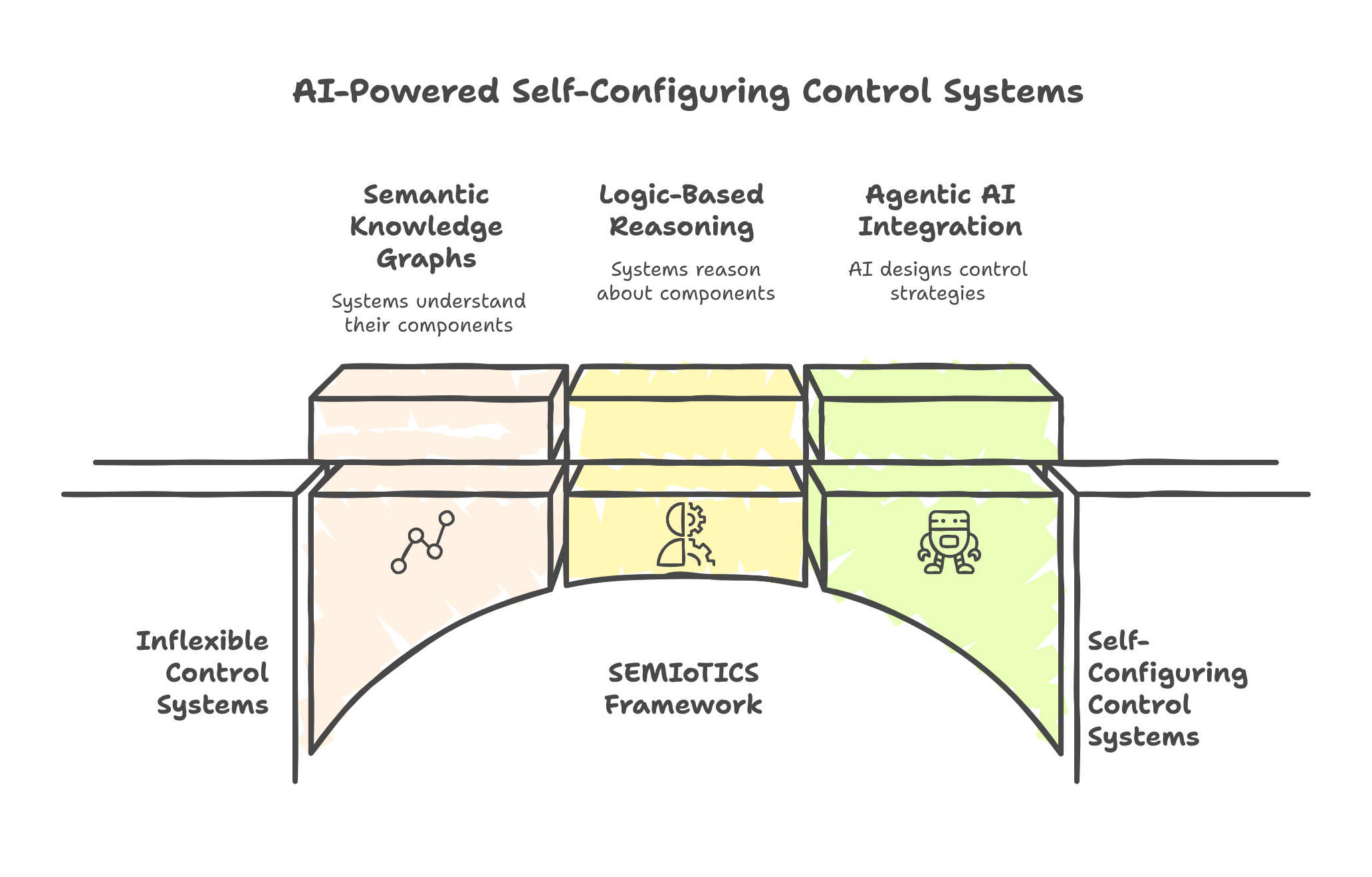
Turning a research vision into action
The core of our work was the design and development of SEMIoTICS, a framework that explored how machines could think about their structure and adapt intelligently to change. In large-scale systems, from smart buildings to energy grids and water networks, sensors, actuators, and controllers work together in complex feedback loops. Traditionally, when a device fails or a new one is added, engineers must replace with same one or redesign the system to restore balance. SEMIoTICS aimed to change that.
A new architecture for intelligent control
SEMIoTICS introduced a supervisor system capable of reasoning about the system using semantic knowledge, not hard-coded logic. When a change occurred, for example, a sensor stopped working or a new heating unit was installed, the supervisor could automatically detect it, understand the implications, and reconfigure the control system online, without interrupting operation.
In essence, SEMIoTICS laid the foundations for self-configuring, knowledge-aware control systems, a step toward what we now recognize as AI-enabled autonomy in engineering systems.
From theory to practice: Self-configuring control in smart buildings
To demonstrate the practicality of this idea, we applied it to smart buildings, environments where comfort, safety, and energy efficiency meet human well-being.
Imagine an office building where heating, ventilation, and air conditioning systems continuously adjust to changing conditions: When a temperature sensor fails, another available device takes over seamlessly; When a new type of device is installed, the control loops reconfigure themselves without manual redesign.
These examples show how semantic reasoning can serve as the missing link between monitoring and control. Monitoring tells us what’s happening; control decides what to do next to achieve certain objectives. SEMIoTICS bridged that gap by giving systems the ability to “understand” the meaning and relationships behind their data.
Beyond buildings: Applications in critical infrastructures
We later extended SEMIoTICS to critical infrastructures such as electric power systems and water distribution networks, the backbone of modern society. In these domains, we showed that semantic reasoning and self-reconfiguration could enable, e.g.,
- Online state estimation in electric power networks, improving reliability under faults or communication failures.
- Adaptive control of water networks, balancing flow and pressure dynamically when demand patterns change.
- Distributed fault detection, where the system itself reasons about sensor data to localize anomalies and trigger responses.
Each of these applications revealed the same underlying principle: when systems are equipped with knowledge about themselves and their environment, they can maintain performance and resilience autonomously.
The road ahead: Challenges and Opportunities
Despite the progress made, there are still many challenges for both control engineers and AI researchers to address. For control engineers, a challenge lies in embedding these new reasoning and learning capabilities into systems that must remain safe, stable, and verifiable. For AI researchers, a challenge is to design autonomous agents that can understand not only language and data, but also physical processes, constraints, and causality, the essence of engineering systems.
Today, with the rise of agentic AI and autonomous reasoning frameworks, this convergence feels closer than ever. Agentic AI can act as the “thinking layer” on top of control architectures, continuously observing, reasoning, and redesigning control strategies in response to changing conditions.
Imagine a power grid that automatically reorganizes itself after a disturbance, maintaining service continuity without human intervention, or a smart city where water distribution, lighting, and mobility systems cooperate through shared reasoning, optimizing for sustainability and comfort. Or an industrial facility that uses AI agents to design, test, and deploy control loops dynamically as production lines evolve.
These examples are no longer science fiction. They represent the next logical step toward self-engineering systems, where engineering intelligence and artificial intelligence merge into a single continuum.
Looking forward
The journey that began with SEMIoTICS continues today, shaped by the same question that guided our research years ago: how can we make complex systems smarter, safer, and more adaptable - not by adding more data, but by teaching them to reason?
As AI tools grow more powerful, we have an extraordinary opportunity to rethink how we design and maintain the systems that sustain our lives. The bridge between control theory and AI is not just technical, it is profoundly human. It is about creating technologies that learn to care for the systems we depend on, freeing engineers to focus on creativity, innovation, and impact.
The next wave of progress won’t come from smarter algorithms alone, but from systems that truly understand their purpose within the world they serve. If this vision resonates with you, as an engineer, scientist, or dreamer, let’s keep building that bridge between human ingenuity and artificial intelligence. I’d love to hear how others see the merging of AI and control engineering.