In his book “Sapiens: A Brief History of Humankind,” [source: Harari, Y. N. (2014). Sapiens: A Brief History of Humankind. London: Harvill Secker] Yuval Noah Harari makes a striking observation:
“If a Spanish peasant had fallen asleep in the year 1000 and woken up 500 years later, the world would have felt familiar. But if someone fell asleep in 1500 and woke up in the 21st century, they would find themselves in a world beyond their comprehension.”
Harari attributes this dramatic shift to the Scientific Revolution, a period that radically transformed human societies by embracing uncertainty, investing in research, and continually expanding the boundaries of knowledge. At the heart of that transformation was a simple but powerful feedback loop:
🔁 Research → Power → Resources → More Research → Greater Capabilities This cycle continues to drive innovation and growth in modern economies.
🔑 The three pillars of innovation
What enabled this leap forward, and what still drives successful innovation today?
In essence:
- Embracing uncertainty: Acknowledging what we don't know fuels curiosity and drives discovery.
- Observation and mathematics: These provide the tools for rigorous analysis and evidence-based knowledge.
- New skills and tools: Empowering people to build new technologies and design innovative solutions.
🌱 A sustainable vision
We need to embrace this understanding, to foster the right mindset and ecosystem for scientific research and innovation to flourish and enable the transition to a sustainable, competitive economy with a strong impact on both European and global progress. But this transition does not happen overnight. It requires coordinated action, guided by smart policies and targeted initiatives.
🧭 The road to innovation
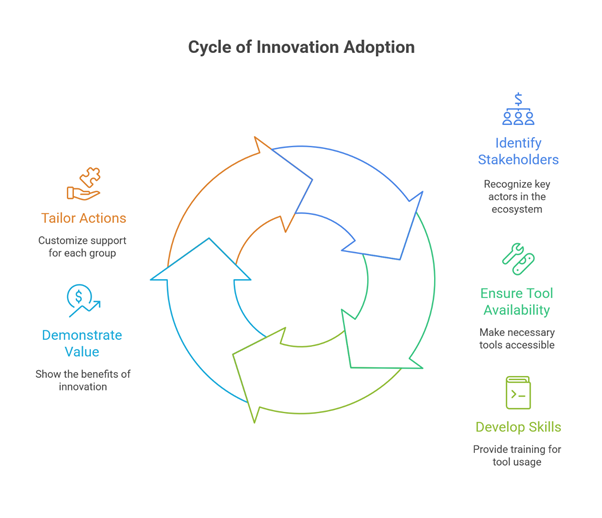
This framework illustrates the key stages needed to enable innovation across society and the economy. It highlights that innovation doesn't happen in isolation. It requires a coordinated, inclusive approach:
- Identify stakeholders: Recognize all relevant actors (citizens, businesses, public sector, policymakers).
- Ensure tool availability: Make technological tools and resources accessible.
- Develop skills: Train people to effectively use those tools.
- Demonstrate value: Clearly communicate the benefits of innovation.
- Tailor actions: Customize support and policy interventions based on each group’s needs.
By continuously cycling through these steps, ecosystems can foster sustainable and inclusive innovation. At the core of this framework is a simple but powerful idea:
✅ Do I have the tools?
✅ Do I know how to use them?
✅ Do I see their value?
Only when the answers are yes across the board can innovation truly take root…in society, in the economy, and in daily life.
🧠 Closing thoughts
Innovation is not just a buzzword or a byproduct of luck. It is a strategic, inclusive, and iterative process, built on curiosity, evidence, and collaboration. As we move forward, let’s ensure that our policies, educational efforts, and investments reflect that reality, to help our society become a genuine engine of progress.
I welcome your thoughts…